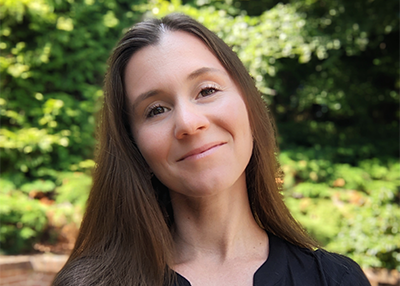
Liliya Khasanova's Visiting Fellowship
In November, Liliya Khasanova joined us for a Visiting Fellowship at The Hague Program on International Cyber Security at Leiden University's The Hague Campus. We sat down with her to hear about her fellowship experience.

Why were you interested in coming here?
I was excited to engage with The Hague Program on International Cyber Security because of its unique combination of deep expertise in international law and its global, policy-oriented outlook on cyber and AI governance. As a comparative international lawyer working on ICT and AI regulation across different jurisdictions — including Russia, China, and the EU — I value spaces that bring together diverse legal and geopolitical perspectives. The Program has built a strong reputation as a hub for thoughtful and practice-oriented discussions on cyber norms, and I had long followed the work of several affiliated scholars. It felt like a natural intellectual home for my current research on global AI governance and regime interactions in data governance.
What did you work on during the fellowship?
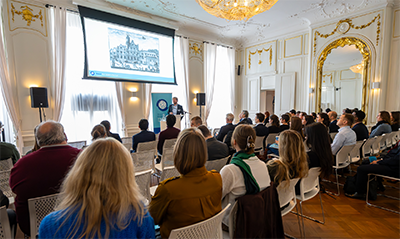
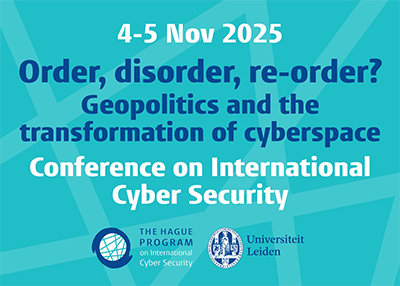
My fellowship began with participation in the Program’s annual conference, which was devoted to the geopolitics of cyberspace, and which was an excellent opportunity to meet the research community. I presented my work on the public-private perspectives on the EU AI Act, particularly examining how different stakeholders influenced the evolution of the legislative text. The feedback and informal conversations were extremely helpful in sharpening my arguments and reworking some parts of the paper.
During the following two weeks, I focused primarily on advancing my research on regime shopping in data governance, which I had the opportunity to present and discuss with the Program’s staff and other fellows. The discussion was valuable in sharpening my conceptual framework and thinking more carefully about the interaction between regional, national, and global regulatory processes. I am grateful for the informal conversations during the fellowship, particularly with Julia Carver, Isabella Brunner, Valentin Weber and Dennis Broeders who inspired me to approach some of the research and teaching practices differently. It was truly a pleasure and rare opportunity to spend time with people who are particularly focused on the international law of cyber space.
Overall, the fellowship provided both concentrated writing time and intellectually rich discussions that significantly strengthened my ongoing projects.
What’s next for you?
Following the fellowship, I plan to further develop both strands of my research here at Fletcher School: the project on public-private perspectives on the EU AI Act and my broader work on regime shopping in data governance. The feedback and discussions in The Hague have encouraged me to think more systematically about how these projects connect to questions of normative competition and global AI governance. In the near term, I aim to finalize and submit these two manuscripts. Broadly, I plan to continue building a research agenda focused on comparative approaches to ICT and AI governance and the evolving structure of the international legal order in this domain. Specifically, I am interested in geopolitics of AI governance, as well as navigating how to bridge the divide between AI industry and AI policymakers.










_400x286.png)


