
Jussi Toivanen's Visiting Fellowship
In November, Jussi Toivanen joined us for a Visiting Fellowship at The Hague Program on International Cyber Security at Leiden University's The Hague Campus. We sat down with him to hear about his fellowship experience.

Why were you interested in coming here?
The Hague Program on International Cyber Security at Leiden University is internationally respected for its comprehensive research and collaboration. The program provides an excellent opportunity to explore the diverse phenomena of cyber security. My research focuses on the management of cyber crises, particularly through the lenses of crisis communication, resilience and strategic communication. In addition, I examine the use of cyber-enabled information warfare in conflicts. The program provided an excellent working environment to support and advance my research themes.
What did you work on during the fellowship?
During my time in The Hague, I prepared a co-authored article for peer review that examines the role of strategic communication in maintaining trust in the context of cyber threats. In addition, I advanced work on another article focusing on the role of effective real-time crisis communications in mitigating cyber threats and strengthening organizational resilience.
From the perspective of my research themes, it was great to see that these topics interested fellow researchers in The Hague. I benefitted greatly from the discussions to further advance my own work. I would like to thank everyone at the Hague campus for the very warm and friendly welcome, as well as for the engaging discussions!
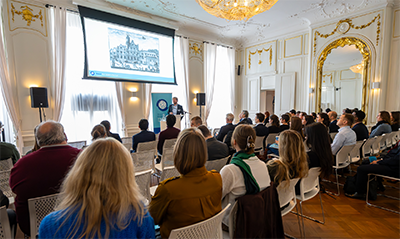
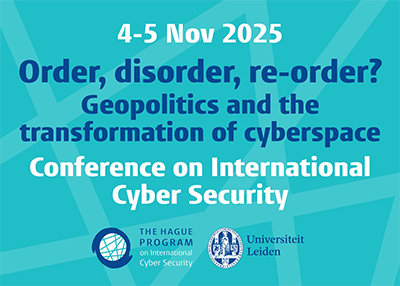
My fellowship coincided with the Program’s annual cybersecurity conference. It was interesting to listen to the presentations and to meet others during the event. This was truly valuable, and the conference itself proved to be a great experience. It was a wonderful opportunity to connect and build networks with cybersecurity researchers from across the world.
As part of my fellowship, I gave presentations on wide range influence operations and on approaches to both preparing for and responding to them. In my presentations, I focused in particular on Finnish examples and experiences. Finland is internationally regarded as a benchmark in preparedness and as a country that has adopted a comprehensive approach to readiness for different types of threats and crises, including cyber threats.
What’s next for you?
After returning to Finland, I resumed my duties as Head of Communications at the Finnish National Cyber Security Centre (NCSC-FI) within the Finnish Transport and Communications Agency Traficom. At the same time, I continue my doctoral studies. My next longer full-time research period will take place in February, when I will spend two weeks at the Technical University of Moldova (Cybercor Institute) in Chișinău.
I am currently preparing an article that analyzes different forms of cyber and information influence operations. It examines how these methods are used jointly and in a coordinated manner to advance strategic objectives, both in the preparation for conflicts and during them. Moldova has long been a target of Russia’s wide-ranging influence operations, and the lessons that can be drawn from Moldova's experiences offer valuable insights for both academic research and for other countries seeking to strengthen their resilience.











_400x286.png)


