
2026 Conference on International Cyber Security: A digital State of Nature? Interdependence, alignment and alliances revisited
The Call for Papers is now open for our 2026 Conference on International Cyber Security - you have until Sunday 17 May 2026 to submit your abstract!

As 2026 unfolds, it looks like international relations are becoming more Hobbesian again. States help themselves and more powerful states openly claim exceptionalism. Seemingly, international law and norms are increasingly lacking state champions to defend and enforce them and, according to Thomas Hobbes, ‘covenants without the sword, are but words, secure to no man at all’.
In the world of digital technology, things are moving and shifting as well. We see the use of AI on the battlefield while diplomats still confer in Geneva about the rules for the use of Lethal Autonomous Weapons Systems (LAWS). Cyber operations have become mainstream in times of both peace and war as the UN starts a new round of negotiations on responsible state behaviour in cyberspace under a new, permanent global mechanism. American AI firms continue to rise on the stock exchange, built on an uncertain promise for the future, but have also become more entwined with American Big Tech platforms, the American defence industry, and Pentagon funding. Digital platforms, infrastructures and supply chains can be – and are – weaponised, fuelling policy reactions on ‘strategic autonomy’ and ‘digital sovereignty’ around the world. Big Tech companies are increasingly becoming more powerful and more political as they flex their muscles internationally. Dependencies, alignments and alliances are being scrutinised, with states marking some out as vulnerabilities and building new ones to counter vulnerabilities.
German Chancellor Scholtz characterised the 2022 Russian invasion of Ukraine as a zeitenwende, a turning point, in Europe’s geopolitical history. In his speech at the Munich Security Conference in January 2026 Canadian Prime Minister Mark Carney said that the "old order is not coming back" as the world is "in the midst of a rupture, not a transition." The first year of the Trump presidency is marked by unilateralism and indicates a return to global great power politics: more swords, less words. As the world is transforming geopolitically, and digital technology is at the centre of that transformation, one question is where we are in that process of transformation. Are we still in the phase of disruption or are we past the turning point and starting to build a new, more realist, world order? What price do we pay for geopoliticisation? Will the EU sacrifice its regulatory power and the green transition on the altar of geopolitics, innovation and industrial policy? How do emerging powers in the majority world view the global political and technological landscape and how will they evaluate risks and opportunities? As the US steps back from the rules-based order will China step forward and seize the opportunity to remodel that order?
In 2026, we want to continue the discussion about interdependencies, alignments and alliances in the digital sphere. Are we heading towards a more realist ‘digital state of nature’, and what does that mean for big, middle and small powers, for technology companies, for supply chains and for political alignments and alliances? What does it mean for international law and norms in cyberspace, and how will it shape cyber diplomacy discussions? In an era of ‘hard power’, or ‘more swords’, what role do cyber and digital technologies play in shifting power dynamics? We hope to see these, and many other related, questions asked and answered at the 2026 Conference on International Cyber Security.
This is the ninth annual academic conference of The Hague Program on International Cyber Security. We welcome all papers that have an interesting take on the theme of A digital State of Nature? Interdependence, alignment and alliances revisited. As always, we aim to bring together scholars from a diverse range of disciplines including – but not limited to – international relations, international law, economics, political economy, security studies, political sociology, philosophy, political science, science and technology studies and engineering. The key to understanding international cyber security lies in bringing together the various disciplines that relate to the theme in a broad sense. This call for papers is therefore open to abstracts from a wide range of academic disciplines.
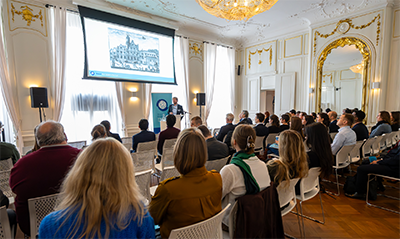
The annual conferences of The Hague Program on International Cyber Security have become a key multidisciplinary venue for peer-reviewed research in the study of cyber security and international stability. See our website for the program and impressions of the previous editions of the conference.
We welcome abstracts of maximum 1600 characters (approximately 250 words) on questions related to the theme of A digital State of Nature? Interdependence, alignment and alliances revisited in a broad sense. We explicitly welcome contributions from early career scholars. The conference will take place in The Hague on 10 and 11 November 2026. Authors of accepted extended abstracts should prepare their full paper by 15 September 2026. A best paper prize will be awarded. Accepted contributors are eligible for funding for travel, lodging, and visa costs and do not need to pay a conference fee.
How to submit your abstract?
- Abstracts can only be submitted through this form: https://fd24.formdesk.com/universiteitleiden/cyberconf2026
- Please make sure your abstract submission meets the following requirements:
- Length: maximum 1600 characters (approximately 250 words)
- Blind review/anonymous: please leave out your name and other identifying details in the submitted abstract text
- Abstracts that do not adhere to the above requirements and/or are not submitted through the form, will not be reviewed.
Important dates
- Submission of abstracts: Sunday 17 May 2026, 23:59 (CET)
- Notification of acceptance: Friday 10 July 2026
- Submission of full paper (max. 6000 words excl. footnotes and literature – for references, preferably use Chicago Manual of Style [preferred citation format being author-date]): Tuesday 15 September 2026
- Feedback by review committee: Thursday 15 October 2026
- Conference presentation: Tuesday 10 and Wednesday 11 November 2026
For questions, please contact us at conference@thehagueprogram.nl










_400x286.png)


